


 Izdanje Srbija
 Serbische Ausgabe
 Izdanje BiH
 Izdanje Crna Gora


 News
News


Transporters announce border crossing blockade – New EU EES system could threaten regional economy

 Comments


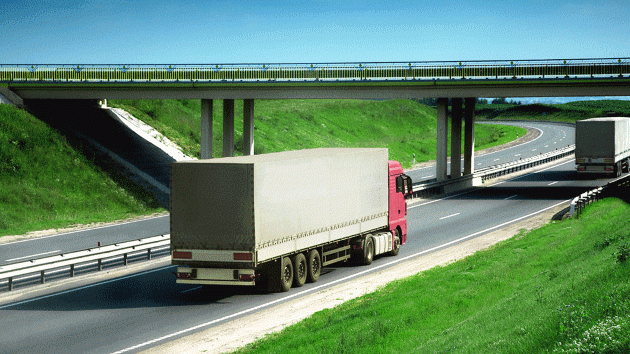
Illustration (Photo: Shutterstock/Michaelvbg)
Professional drivers’ associations from Serbia, Montenegro, Bosnia and Herzegovina and North Macedonia announced a blockade of border crossings with neighboring Schengen countries on January 26, due to the problems caused by the new EES system for entering and exiting countries in Europe.
The system envisages registration of citizens from non-EU countries who travel for a short stay, each time they cross the external borders of any of the following European countries that use the system.
This short stay includes up to 90 days in any 180-day period.
As explained by the drivers’ associations, they are organizing the protest due to the inadequate reaction of the European Commission and the Schengen countries regarding the treatment of professional drivers from this region and the restriction of their stay in the territory of these countries during their daily work activities.
During a press conference several days ago, they announced that they had started alerting the public and announcing protests immediately, due to the danger of losing the already scarce workforce in this industry.
According to their announcements, this problem will not only affect professional drivers, but also the entire domestic economy, and consequently the population.
However, as they pointed out, companies already do not have enough drivers and their trucks are sitting in the parking lot, and this problem is increasing since this system was announced, because drivers are afraid of what will happen.
Out of this fear, many are already leaving this job or announcing their departure, they warned and added that the closer that date got, the fewer drivers there would be.
They also said that if our drivers do not perform these transports, supply chains will be jeopardized, not only in the Western Balkans, but also in Europe.
Nedjo Mandic from the Association of Transporters of Serbia pointed out that road transport, as an industry in the Western Balkans, had many problems, but that now they were talking about a problem that had not yet escalated, but whose consequences could be “catastrophic for the population of our countries.”
When the introduction of the EES system was announced, as he explained, controls became more frequent, and those responsible did not lift a finger.
– We announced the protest to prevent a total collapse – emphasized Mandic.
However, he added, if those responsible in Europe take this opportunity for talks seriously, there will probably be no protests.
– We are not asking much, just to solve a problem that is easily solvable – he said.
Mandic warned that the Schengen Agreement had become its own opposite, because its idea had been to facilitate the flow of goods and capital.
– We believe that it is time to amend the Schengen Agreement, so that new, acceptable solutions can be adopted a little better. We call for a meeting with experts from the European Commission (EC) to be scheduled tomorrow and for a solution to be found by the end of March – he said.
According to him, drivers should be treated as cross-border workers, not migrants.
– A professional driver is not a migrant, nor is someone who enters the Schengen area to work illegally – Mandic emphasized.
He reminded that they do not have the right to prevent a driver from doing their job if they have the correct personal documents, if they drive a truck of an employer who has registered them as a professional driver, if they have permits from the Ministry of Transport and which are agreed on a bilateral basis with all countries, if they have the correct documentation for the vehicle and the goods they are transporting and if they have not previously been banned from entering the Schengen area.
– We support the intention to prevent illegal work, but our drivers work legally. Their stay in the Schengen area is only until the necessary task is completed – he explained.
The problem, in his opinion, is artificial and has arisen due to the inactivity of the Brussels administration, to which this appeal and protests are addressed.
– The bottom line is that drivers can stay in the Schengen area for a maximum of 15 days a month, and the day of entry is considered the first day of stay, and the day of return is the last day of stay. If you enter or exit at 12.10 AM, it counts as a full day. If you do it a few times, that’s five or six days less. There’s a maximum of 10 days left to work, and working 10 out of 30 days is not economically viable – he warned.
Mandic added that it happened sometimes that drivers ended up there on a weekend and had to spend those two days there because of the driving ban. He explained that the more kilometers a transporter travels, the more income they make.
– When you add to that the congestion at the borders, we can only travel 7,000 or 8,000 kilometers, while drivers in the EU can travel 15,000 kilometers, so, twice as much – he said.
However, not only the drivers are affected by this, he added.
– The economy will bear the consequences because someone has to transport the product that exists to the buyer in the Schengen area. Or someone needs to have raw materials brought in from that area. And the population, which is used to some products, will suffer because some products will not be available or there will be fewer of them and they will be more expensive – warned Mandic.
He also noted that if those from this area do not drive, no one will drive under the conditions under which they drive.
– Our drivers suffer from waiting at the borders, sometimes up to 72 hours. And a transporter from Western Europe has no borders and just drives – he explained.
He added that there were about 30,000 drivers in Serbia alone, and that the number was much higher in the region.
As for cooperation with the state in solving this problem, Mandic stated that they had good cooperation with the Prime Minister’s Office.
Meetings were held to resolve internal problems, but this problem was also discussed, he said.
He reminded that Serbia was not in the Schengen area and that because of that, no one in the country could guarantee them anything, but that they had received support and that state officials had spoken publicly about this problem.
Djordjije Ljesnjak from the Association of Transporters of Montenegro accused the EU of doing this with a hidden agenda.
– We believe that this is a cunning intention of the EU to get the highest quality workforce and take over all our drivers, so that we are forced to move our companies to the EU area – he pointed out.
He emphasized that the working conditions for drivers in their home areas were already difficult.
– Drivers will be prevented from working here, but it will not be a problem for them because they can switch to driving for transporters from the EU, which will reduce the labor deficit. This way we will get refugee companies and refugee workers – Ljesnjak pointed out.
He also said that the state of Montenegro did not stand behind them.
– In Montenegro, communication with the state administration is almost non-existent. No one has ever invited us to hear our problems. Even when the state administrations of Bosnia and Herzegovina and Serbia approached them to participate as a single bloc, the answer was that we are getting closer to joining the EU and that this problem will not exist for us, but until we join, Montenegrin transport will not exist – emphasized Ljesnjak.
As he added, not only are they not helping them, but they suspect that the state is making things more difficult for them.
Representatives of drivers from BiH Dino Durmic and Amir Hadzidedic said that this was a common problem for the entire region.
They added that drivers in that country were quite united, because they had had protests the year before when they had been solving some domestic issues.
As for help from the state, they stated that there had been support from the ministry, but that nothing concrete had been achieved.
They also said that the Schengen zone was their first border and that wherever they went, they were in that area, which is why the rule was a big problem.

Tags:
Association of Transporters of Serbia
Association of Transporters of Montenegro
Neđo Mandić
Đorđije Lješnjak
Dino Durmić
Amir Hadžidedić
border crossing blockade
EES system
Comments
Your comment
Naš izbor
Most Important News
Full information is available only to commercial users-subscribers and it is necessary to log in.
Pratite na našem portalu vesti, tendere, investicione projekte, grantove i pravnu regulativu.
Registracija na eKapiji vam omogućava pristup potpunim informacijama i dnevnom biltenu
Naš dnevni ekonomski bilten će stizati na vašu mejl adresu krajem svakog radnog dana. Bilteni su personalizovani prema interesovanjima svakog korisnika zasebno,
uz konsultacije sa našim ekspertima.