


 Izdanje Srbija
 Serbische Ausgabe
 Izdanje BiH
 Izdanje Crna Gora


 News
News


New rules for drones in Serbia – Flights prohibited along border, highways, state and industrial facilities
Source: eKapija
 Wednesday, 12.08.2026.
13:17
Wednesday, 12.08.2026.
13:17
Wednesday, 12.08.2026.
13:17
 Comments


Illustration (Photo: bibiphoto/shutterstock)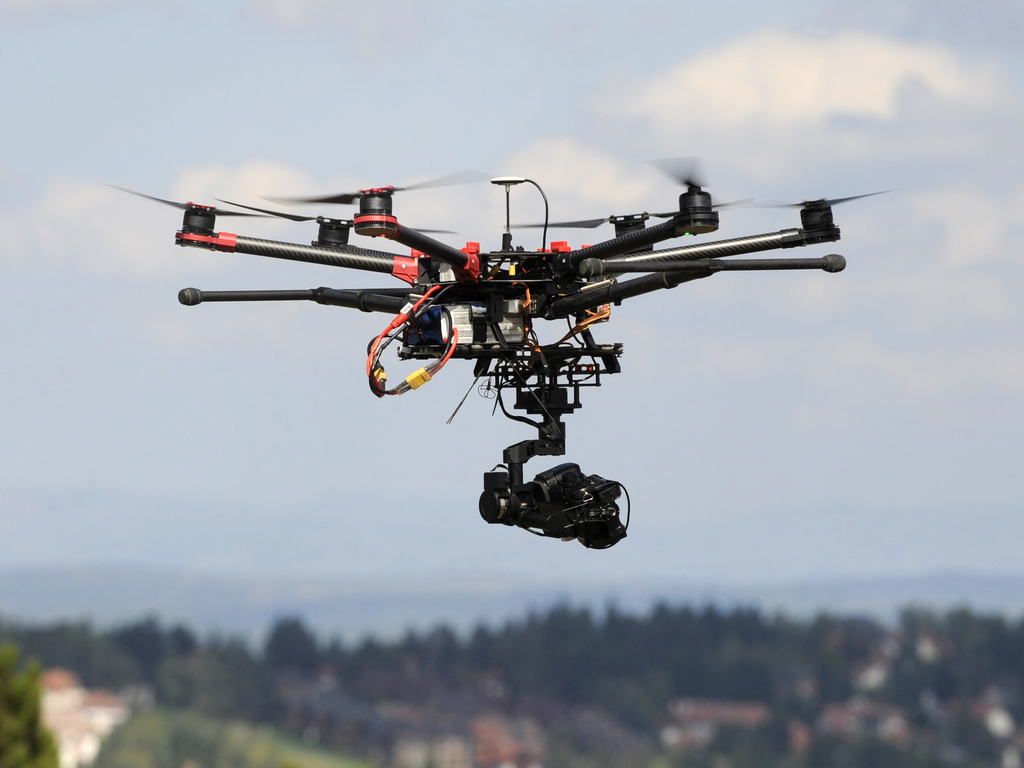
According to the new rules, drone users will have to check the geographic zones and current restrictions available via a mobile application before flying. Restrictive zones will be marked in orange, and prohibited ones in red.
Up to 120 meters free, but not everywhere
A free zone for drone flights is considered a part of the airspace up to 120 meters high, unless it is located in one of the prescribed restrictive or prohibited zones and is not subject to other restrictions.
For flights above 120 meters, prior airspace allocation will be required, with the approval of the Civil Aviation Directorate.
Special restrictions apply to the area along the state border. Drone flights will be prohibited within 300 meters of the border line, unless the operator obtains approval from the Directorate based on the prior consent of the Ministry of Internal Affairs and uses a drone with an active remote identification system.
Even stricter rules apply along the administrative line with Kosovo and Metohija. Flights within 5 kilometers will be prohibited, except with prior approval from the Ministry of Defense, notification of the competent police unit at least 48 hours in advance, and an activated remote identification system.
Restrictions around military and state facilities
Drones will not be allowed to fly above or within 500 meters of facilities and complexes used by the Ministry of Defense and the Serbian Armed Forces, the Ministry of Internal Affairs, and the Security and Information Agency.
For training ranges, this distance is 1,000 meters, while for military and police units outside their facilities, the prescribed distance is 500 meters.
Certain locations may also be declared completely prohibited zones.
The new rules also cover state institutions. Flights will be prohibited above and within 500 meters of the National Assembly, the Government and the General Secretariat of the President of the Republic, while the facilities of ministries, courts, prosecutors’ offices, foreign embassies and consulates, international organizations and correctional institutions will be subject to a 150-meter limit.
Flights in these zones can be carried out with special permission from the Directorate, with prior consent from the Ministry of the Interior and the use of a drone with active remote identification.
Stricter rules around airports
The regulation introduces special rules for flights near airports and heliports.
Drone operations within the boundaries of airports and heliports will be prohibited, except with the permission of the airport or heliport operator and the appropriate operational permission from the Directorate.
For the six airports listed in the regulation – Belgrade/Nikola Tesla, Nis/Constantine the Great, Uzice/Ponikve, Belgrade/Batajnica, Kraljevo/Morava and Vrsac – the proximity of the airport is defined as an area extending 3 kilometers from each edge of the basic runway.
For other airports, this zone is 1.5 kilometers.
However, there is an exception for operations in the open category: a drone can fly without the Directorate’s approval and without airspace allocation if it is at an altitude of up to 30 meters and at least 1 kilometer from each edge of the basic runway.
Similar rules apply to heliports, where the proximity zone is generally calculated as a circle with a radius of 1.5 kilometers.
Drones not allowed to follow motorways and railroads
The new regulation also restricts flights over road and rail infrastructure.
It is prohibited to fly over a highway, hover over it and continuously fly along the highway, as well as to fly in a 20-meter zone on both sides of the highway.
However, flying over a highway is possible in the open category A1 or A2 if the drone flies at least 20 meters above the highway, the pilot maintains visual contact with the aircraft and takes measures to reduce the risk to drivers. In A2 operations, there must be no vehicles in motion during the flight.
For roads that are not highways, hovering and continuously flying along the road is also prohibited, as well as flying in a 20-meter zone on both sides, except when there is no motor vehicle traffic. Flying over the road itself is permitted, provided that a minimum height of 20 meters and visual contact are maintained.
For main rail lines, hovering and continuously flying along the track and in a 20-meter zone on both sides is prohibited. Flying over railway lines is permitted with a minimum height of 20 meters and visual contact.
Restrictions also apply above factories, energy facilities and waterworks
Drone flights will be prohibited above and within 100 meters of industrial facilities, significant power facilities and drinking water supply facilities.
If explosive or toxic substances, flammable and combustible liquids or flammable gases are produced, used or stored in the facility, the protective distance increases to 500 meters.
An exception is possible with the approval of the owner or user of the facility.
Drones and residential buildings
The new rules also regulate flights near residential buildings.
Flights at a horizontal distance of less than 15 meters from residential, residential-commercial buildings and family houses are prohibited, as well as flights at a height of less than 50 meters above these buildings.
Exceptions exist when it is necessary for take-off or landing, when there is consent from the housing association or the owner or user of the house, as well as for certain class C0 drones that are not equipped with recording devices.
An exception is also provided for works on communal infrastructure, with the obligation to inform residents in advance.
Special nature protection
Flights will be prohibited above protected areas with a level I protection regime.
From February 1 to July 15, flights above and at a distance of less than 500 meters from the nesting sites of strictly protected wild species of birds of prey are also prohibited.
An exception is possible with the approval of the manager of the protected area, or the institute responsible for nature protection when the nesting site is located outside the protected area.
Possibility of forced landing of drones
The regulation also provides for the possibility of applying measures against drones that fly contrary to the prescribed conditions.
In the event of an unauthorized operation, military units, police units or the competent security and information organization may apply measures aimed at grounding or disabling the drone.
Operators and remote pilots will be responsible for checking zones and complying with conditions before each flight, while data on zones, operators, pilots, drones and active flights will be used through a mobile application.
The Regulation entered into force on the eighth day after its publication, but its implementation begins on October 29, 2026.
I. Z.
Read the Regulation document (in Serbian) in the PDF file.
Companies:
 Vlada Republike Srbije
Comments
Your comment
Naš izbor


Most Important News
Full information is available only to commercial users-subscribers and it is necessary to log in.
Pratite na našem portalu vesti, tendere, investicione projekte, grantove i pravnu regulativu.
Registracija na eKapiji vam omogućava pristup potpunim informacijama i dnevnom biltenu
Naš dnevni ekonomski bilten će stizati na vašu mejl adresu krajem svakog radnog dana. Bilteni su personalizovani prema interesovanjima svakog korisnika zasebno,
uz konsultacije sa našim ekspertima.