




Ksenija Karic, Country General Manager of Schneider Electric – Digitalization Leads to Energy Savings
Schneider Electric is celebrating an important anniversary this year – two decades of operations in Serbia. They are proud of everything that they’ve achieved so far, but they are already looking toward the future. The next decade is crucial, because everything we build in the next 10 years will be what we will use in the next 50, they believe at the company.
Ksenija Karic, Country General Manager at Schneider Electric, says that 72% of the company’s revenues are now green, and she also reveals how smart solutions can contribute to energy efficiency and which technologies await us in the future.
Schneider Electric is a company which has been pronounced as the most sustainable in the world in the past years, as well as one of the most influential ones in this field. What are the guiding goals in your business?
– We deal with energy solutions which have as their goal: efficiency, financial savings and a reduction of climate change impact. We are a global leader in developing innovative solutions in automation and energy management.
Digitization and automation of a business and business processes, energy savings and CO2 emission reductions are the persistent demands of the time we live in and they pertain to everything, the private sector, the public sector, small and medium enterprises, companies. We are all invited to upgrade the concept of our work or we will not survive in the market. As a leader in automation and energy savings, in this fact we see a big opportunity to help, but also a great challenge and responsibility.
It is precisely with the aim of realizing sustainability that we offer smart solutions. For example, through products for supervision and management, we create buildings of the future and in “smart buildings” we support the striving for a lower consumption of energy and the energy efficiency of the facility, which is an increasingly common request.
When it comes to sustainability, we are not just trying to set an example when it comes to the way we run our own operations, but we are also part of the solution for many of our clients. 72% of the company’s revenues are now green – which incudes all the technologies you can develop to improve energy efficiency and CO2 emission reduction.
Our products are green, for example, SM AirSeT modular facilities and medium-voltage facilities for commercial and industrial facilities, which use a filtered air technology instead of SF6 gases.
We strive to set an example and play an important role in creating a carbon-free world, while at the same time helping clients operate in more sustainable way, with a considerable reduction of costs. This means that digitization and Industry 4.0, along with Electricity 4.0, contribute to economic competitiveness.
You develop software which brings big savings and advocate digitization in order to reach Industry 4.0. In your opinion, what are the challenges that digitization brings to companies and what are the biggest advantages?
– Company digitization means energy savings and reduction of carbon emission, reduction of costs, higher efficiency. When you talk to executive directors, they know in great detail how much IT costs, but they often don’t know what the energy costs are, so they don’t know what their emissions are. So, the first thing is to use digitization for measuring, and the second is to use it to save.
What we do is to integrate the two, which was previously not possible. Today, when everything is connected, you can integrate both, so that everybody has data visibility and so that you can manage the software which gives you a visibility of the whole system throughout its life cycle. Also, now that you have several facilities, you can manage them from one place and have the whole system be visible, not just per facility. You can compare and, based on real data, make decisions regarding investments, retrofit etc.
Time is a challenge. The reality is that the next decade is crucial, considering that, what we build in the next 10 years will be what we will use in the next 50 years. That is a challenge that stands before us all and which should bind us all. That is why the decisions that we make now are crucial.
Energy efficiency is a burning issue and, as such, has become very important in the past years. Which trends and solutions are current at the moment?
– Energy efficiency and sustainability are imperative in today’s time, not just in Serbia, but also globally.
Additionally, the problem of climate change cannot be solved without a transformation of cities and buildings, because as much as 70% of the impact on the emissions worldwide comes from cities. According to the Paris Agreement, until 2050, all buildings need to have zero net emission of CO2, and this process will be based on several key formulas. Buildings must become ultra-efficient. They need to be fully electrified. Systems within the facility need to be ready to rely on RES and work with flexible energy sources owned by the facility itself, connected with modern and digitized networks, in order to increase the total resilience and system efficiency.
A combination of efficient, fully electrified and digitized distribution networks, a greater use of distributed energy production, investing in energy storage and electro-mobility will help with the management and control of energy demands, and the full digitization of power grids will upgrade the total energy demands of cities, the resilience of cities through automation and real-time notifications.
What awaits us in the future, which technologies and how will they be implemented?
– Future technologies mostly pertain to the implementation of artificial intelligence in all fields, in the near future. Now, regarding the ways that concern our company, we have three ways for artificial intelligence to shape energy management:
More efficient energy use – Companies collect large amounts of data that they can use in order to increase efficiency.
Diversification of energy sources – Industry automation can support companies in implementing RES and controlling their carbon footprint – giving clean energy a better chance in the market. Companies which produce their own renewable energy can apply AI and predictive analytics on time conditions – the data which then help determine the time needed for production. That way, they optimize the use of the system for the storage of distributed energy or batteries.
Smarter energy purchase – Industry automation can test complex market trends and dissect the data in order to design plans for a better management of energy consumption and reduce the risks in an unstable market. This technology can also monitor when and how companies spend energy and supports their trading. For example, companies which spend and produce energy can get guidelines for reaching optimal decisions about when to sell the surplus energy from their renewable sources.
Our solutions already use artificial intelligence to optimize operations, helping our clients achieve energy transparency and spend less energy.
How does this look in practice?
We can take as an example the distribution center of the retailer Lidl in Finland. Here, the EcoStruxure Building Operation software “teaches” the building management system to predict and optimize energy use. The system works together with the EcoStruxure Microgrid Advisor, so that the energy is produced, consumed or stored exactly where needed, saving 70% on energy costs.
Ksenija Karic, Country General Manager at Schneider Electric, says that 72% of the company’s revenues are now green, and she also reveals how smart solutions can contribute to energy efficiency and which technologies await us in the future.
Schneider Electric is a company which has been pronounced as the most sustainable in the world in the past years, as well as one of the most influential ones in this field. What are the guiding goals in your business?
– We deal with energy solutions which have as their goal: efficiency, financial savings and a reduction of climate change impact. We are a global leader in developing innovative solutions in automation and energy management.
Digitization and automation of a business and business processes, energy savings and CO2 emission reductions are the persistent demands of the time we live in and they pertain to everything, the private sector, the public sector, small and medium enterprises, companies. We are all invited to upgrade the concept of our work or we will not survive in the market. As a leader in automation and energy savings, in this fact we see a big opportunity to help, but also a great challenge and responsibility.
It is precisely with the aim of realizing sustainability that we offer smart solutions. For example, through products for supervision and management, we create buildings of the future and in “smart buildings” we support the striving for a lower consumption of energy and the energy efficiency of the facility, which is an increasingly common request.
When it comes to sustainability, we are not just trying to set an example when it comes to the way we run our own operations, but we are also part of the solution for many of our clients. 72% of the company’s revenues are now green – which incudes all the technologies you can develop to improve energy efficiency and CO2 emission reduction.
Our products are green, for example, SM AirSeT modular facilities and medium-voltage facilities for commercial and industrial facilities, which use a filtered air technology instead of SF6 gases.
We strive to set an example and play an important role in creating a carbon-free world, while at the same time helping clients operate in more sustainable way, with a considerable reduction of costs. This means that digitization and Industry 4.0, along with Electricity 4.0, contribute to economic competitiveness.
You develop software which brings big savings and advocate digitization in order to reach Industry 4.0. In your opinion, what are the challenges that digitization brings to companies and what are the biggest advantages?
– Company digitization means energy savings and reduction of carbon emission, reduction of costs, higher efficiency. When you talk to executive directors, they know in great detail how much IT costs, but they often don’t know what the energy costs are, so they don’t know what their emissions are. So, the first thing is to use digitization for measuring, and the second is to use it to save.
What we do is to integrate the two, which was previously not possible. Today, when everything is connected, you can integrate both, so that everybody has data visibility and so that you can manage the software which gives you a visibility of the whole system throughout its life cycle. Also, now that you have several facilities, you can manage them from one place and have the whole system be visible, not just per facility. You can compare and, based on real data, make decisions regarding investments, retrofit etc.
Time is a challenge. The reality is that the next decade is crucial, considering that, what we build in the next 10 years will be what we will use in the next 50 years. That is a challenge that stands before us all and which should bind us all. That is why the decisions that we make now are crucial.
Energy efficiency is a burning issue and, as such, has become very important in the past years. Which trends and solutions are current at the moment?
– Energy efficiency and sustainability are imperative in today’s time, not just in Serbia, but also globally.
Additionally, the problem of climate change cannot be solved without a transformation of cities and buildings, because as much as 70% of the impact on the emissions worldwide comes from cities. According to the Paris Agreement, until 2050, all buildings need to have zero net emission of CO2, and this process will be based on several key formulas. Buildings must become ultra-efficient. They need to be fully electrified. Systems within the facility need to be ready to rely on RES and work with flexible energy sources owned by the facility itself, connected with modern and digitized networks, in order to increase the total resilience and system efficiency.
A combination of efficient, fully electrified and digitized distribution networks, a greater use of distributed energy production, investing in energy storage and electro-mobility will help with the management and control of energy demands, and the full digitization of power grids will upgrade the total energy demands of cities, the resilience of cities through automation and real-time notifications.
What awaits us in the future, which technologies and how will they be implemented?
– Future technologies mostly pertain to the implementation of artificial intelligence in all fields, in the near future. Now, regarding the ways that concern our company, we have three ways for artificial intelligence to shape energy management:
More efficient energy use – Companies collect large amounts of data that they can use in order to increase efficiency.
Diversification of energy sources – Industry automation can support companies in implementing RES and controlling their carbon footprint – giving clean energy a better chance in the market. Companies which produce their own renewable energy can apply AI and predictive analytics on time conditions – the data which then help determine the time needed for production. That way, they optimize the use of the system for the storage of distributed energy or batteries.
Smarter energy purchase – Industry automation can test complex market trends and dissect the data in order to design plans for a better management of energy consumption and reduce the risks in an unstable market. This technology can also monitor when and how companies spend energy and supports their trading. For example, companies which spend and produce energy can get guidelines for reaching optimal decisions about when to sell the surplus energy from their renewable sources.
Our solutions already use artificial intelligence to optimize operations, helping our clients achieve energy transparency and spend less energy.
How does this look in practice?
We can take as an example the distribution center of the retailer Lidl in Finland. Here, the EcoStruxure Building Operation software “teaches” the building management system to predict and optimize energy use. The system works together with the EcoStruxure Microgrid Advisor, so that the energy is produced, consumed or stored exactly where needed, saving 70% on energy costs.
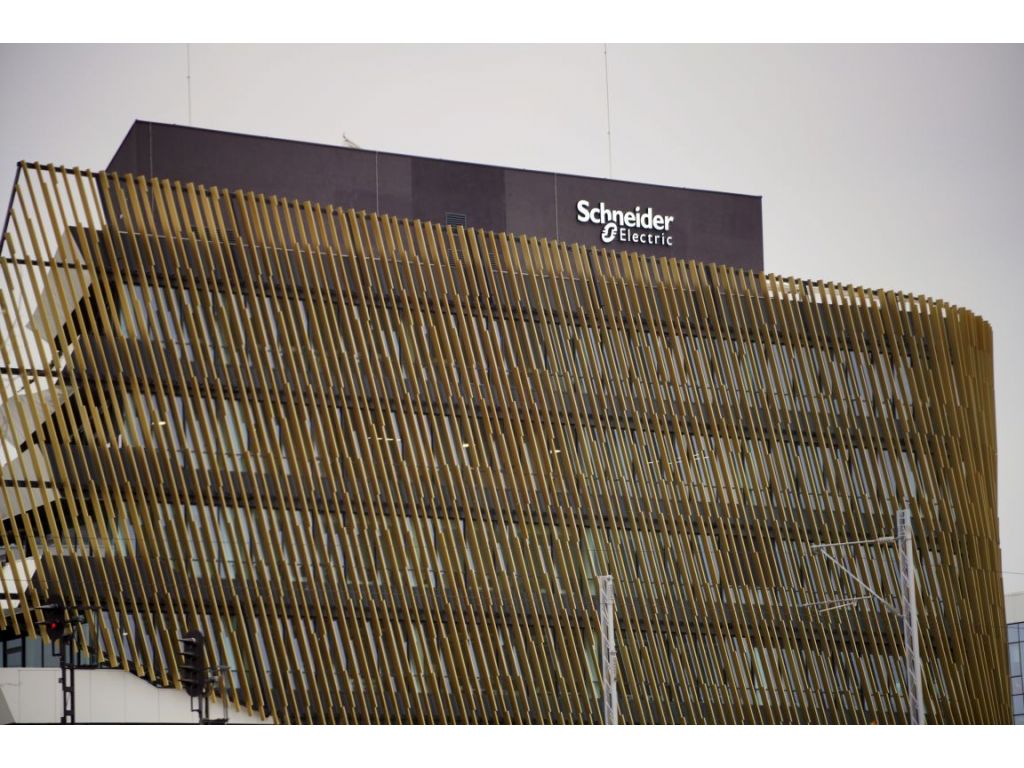
This year, Schneider Electric is also celebrating an important anniversary in Serbia – 20 years of operations. How would you sum up the past two decades?
– Looking back, there are many aspects of our operations so far that should be highlighted and that we are extremely proud of.
We realized a range of projects in which we helped our clients realize their business goals, at the same time taking care of sustainable business operations.
Last year alone, our solutions were implemented in the factories of Minth Automotive Europe in Loznica and Sabac, in Shopping Center Delta Planet in Nis, in the Delta HQ management building in Belgrade, in the car part factory Xing Yu in Nis and in many others.
We have developed a network of partners which now encompasses more than 100 local companies. We are especially proud of our license partners, which produce equipment in line with the Schneider Electric technologies.
Our Hub, with over 1,000 employees, dealing with software engineering in the field of electrical energy and paying special attention to investing in knowledge and young talents, students of technical faculties, through various trainings, scholarships and mentorship programs, also operates in Serbia. Our entities in Belgrade and Novi Sad have developed cooperation with technical faculties in nearly all university centers, enabling the transfer of knowledge in the best way. The scholarship program that our company implements is designed to provide support to the students who deal the best with faculty challenges and further motivate them to be proactive and successful during their studies, without an obligation to stay and work for us.
We have also dedicated ourselves to educating young generations through the Center for Young Talents, which was founded ten years ago. With the aim of contributing to the development of theoretical and practical knowledge in mathematics and programming, we have organized free classes for over 6,000 children, and we have realized over 5.5 thousand hours of education, of which as many as 535 hours in 2021 alone.