


 Izdanje Srbija
 Serbische Ausgabe
 Izdanje BiH
 Izdanje Crna Gora


 News
News


Danube under watchful eye of artificial intelligence – New system for monitoring river quality developed at FTN and Institute for AI

 Comments


Danube (Photo: Aleksandar Parezanović)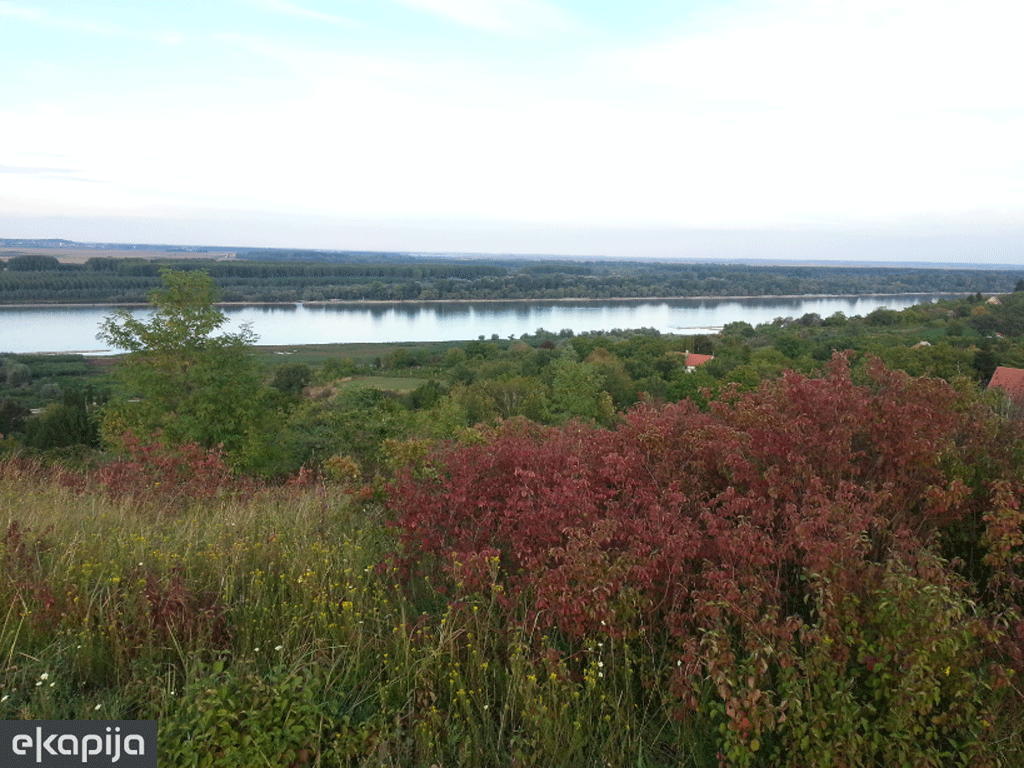
In order to improve the decision-making process and improve the health of rivers, the Faculty of Technical Sciences (FTN) at the University of Novi Sad and the Institute for Artificial Intelligence of Serbia have gathered a research team around the REWARDING project, which is focused on the design, implementation, setup and demonstration of a pilot system for collecting and analyzing data on water quality in water courses.
– Colleagues from the Department of Energy, Electronics and Telecommunications at FTN are working on a project to develop the technical part of the system: smart buoys and drones, which would collect data and transmit it through the mobile network to the central part of the system for storing and processing that data – says Dr. Dejan Vukobratovic, Associate Professor at the Faculty of Technical Sciences and Project Manager of the REWARDING project.
– Colleagues from the Department of Environmental Protection are domain experts who understand that data, while the expertise of the team from the Institute of Artificial Intelligence is focused on processing the data itself and developing a machine learning model that, in the future, can play an important role in predicting anomalies and alerting system users. And the essence of the entire system is to strengthen river water quality monitoring, because it brings the possibility of collecting data and monitoring key water quality indicators in real time from any location and at any time.
Water quality in Serbia is monitored primarily by the Environmental Protection Agency of the relevant ministry, which has established a national monitoring network covering around 120 measuring stations throughout the country, on all major and medium-sized rivers: Danube, Tisa, Sava, Drina, Morava... Measurements are usually performed at these measuring stations once a month and physical-chemical parameters, biological parameters, and specific chemical pollutants such as heavy metals, pesticides, polycyclic aromatic hydrocarbons and industrial pollution are monitored. Of course, depending on the hydrological conditions and the possible level of pollution, water quality is monitored more frequently at some of the locations, so a daily measurement schedule has been established at six locations: one on the Danube in Novi Sad, two each on the Sava and Morava rivers, and one on the Ibar - where 19 water quality parameters are monitored, including the color, odor, temperature, electrical conductivity, dissolved oxygen level...
– This type of water quality monitoring has its drawbacks, primarily in that the data is limited in time and space, i.e. we rely on manual measurements and there is no real-time data. All of this led us to design a sustainable, autonomous system within the REWARDING project that integrates modern technologies, artificial intelligence, and relies on multiple data sources simultaneously – explains Dr. Jelena Radonic, Full Professor at FTN.
– So, within the project, we increased the temporal resolution of water quality data by using smart traveling buoys. These buoys are equipped with sensors that measure targeted water quality parameters in real time. On the other hand, we increased the spatial resolution by using drones, which take samples from different parts of the river at points between the buoys, with a special emphasis on inaccessible locations with potentially increased pollution. Finally, we used satellite data to complement the existing ones.
Sensors integrated on smart buoys measure four water quality parameters in real time: temperature, electrical conductivity, dissolved oxygen and pH value. These parameters were chosen because they are ecologically very important, and they are also highly sensitive to the presence of various other pollutants in water, such as heavy metals or organic substances, such as pesticides. This created the conditions for rapid detection and identification of pollution sources. At the same time, it is also important that the sensors that measure these parameters are technically available, reliable and, most importantly, compatible with IoT (internet of things) systems equipped with smart floating buoys and drones.
– The Danube was chosen for the implementation of the pilot system, given its densely populated environment and the endangered ecological status of the river. Of course, the system can be used on any other river, lake, water intake... – emphasizes Dr. Vukobratovic.
– In fact, the potential applications of such a system are numerous, because there are both public and commercial entities that would benefit greatly from it, such as, for example, fish farms. We are even convinced that professional river anglers and even sport fishermen could be interested in a mini-version of such a system with an accompanying mobile application, because they could receive real-time information about the water quality at the exact location where they are fishing. Another important application is the ability to place the system anywhere and have access to key data at critical moments. An example of this are the numerous canals in Vojvodina, which can have higher or lower water levels during different parts of the season. If you have the ability to easily take a series of measurements at different locations, you can determine in time that, for example, the level of dissolved oxygen has decreased in a canal and respond accordingly, for example by raising the dam and increasing the inflow, thus preventing the dying of the fish.
AI for predicting problems
As part of the REWARDING project, researchers from the Institute for Artificial Intelligence worked, among other things, on developing machine learning models for predicting surface water quality parameters. In order to develop these models as reliably as possible, it was important that all collected data, both old and new, both those from the Environmental Protection Agency and those collected with the help of buoys and drones, be actively used for their training.
“When a problem or even an accident occurs today, it is very valuable information for us in the future so that the models can be retrained on this new data so that such a change can be predicted later,” explains Ana Dodig, a researcher at the Institute for Artificial Intelligence.
– It is very important that these models, in addition to raising alarms in the event of a deterioration in water quality, can also indicate that a problem has occurred with one of the measuring devices...
Companies:
 Fakultet tehničkih nauka Univerziteta u Novom Sadu
 Istraživačko-razvojni Institut za veštačku inteligenciju Srbije Novi Sad
 Agencija za zaštitu životne sredine Beograd
Tags:
Faculty of Technical Sciences at the University of Novi Sad
Institue for Artificial Intelligence of Serbia
Environmental Protection Agency
Dejan Vukobratović
Jelena Radonić
Ana Dodig
REWARDING research team
water quality in Serbia
Comments
Your comment
Naš izbor


Most Important News
Full information is available only to commercial users-subscribers and it is necessary to log in.
Pratite na našem portalu vesti, tendere, investicione projekte, grantove i pravnu regulativu.
Registracija na eKapiji vam omogućava pristup potpunim informacijama i dnevnom biltenu
Naš dnevni ekonomski bilten će stizati na vašu mejl adresu krajem svakog radnog dana. Bilteni su personalizovani prema interesovanjima svakog korisnika zasebno,
uz konsultacije sa našim ekspertima.