


 Izdanje Srbija
 Serbische Ausgabe
 Izdanje BiH
 Izdanje Crna Gora


 News
News


Ana Radovanovic, energy expert at Google – AI as challenge for energy

 Comments


(Photo: jamesteohart/shutterstock.com)
The United States is currently experiencing rapid growth in electricity demand. Studies show that the total peak load in the US could increase by up to 21.5% over the next decade.
Data centers and electricity consumption
The reason for a large part of this increase is data centers. According to a report by the Lawrence Berkeley National Laboratory, data centers accounted for as much as 4.4% of total electricity consumption in the US.
This share is expected to increase to between 6.7 and 12% of total consumption by 2028. By 2030, their share of total consumption could become equal to the current share of renewables in total production, and similar growth trends are being recorded in China, Europe and Japan.
Although there are different types of data centers, those built by information technology giants (Google, Microsoft, Meta, Amazon…) are called hyperscalers due to their size and typically consume more energy than 500,000 households.
(Photo: Mikhail Starodubov/shutterstock)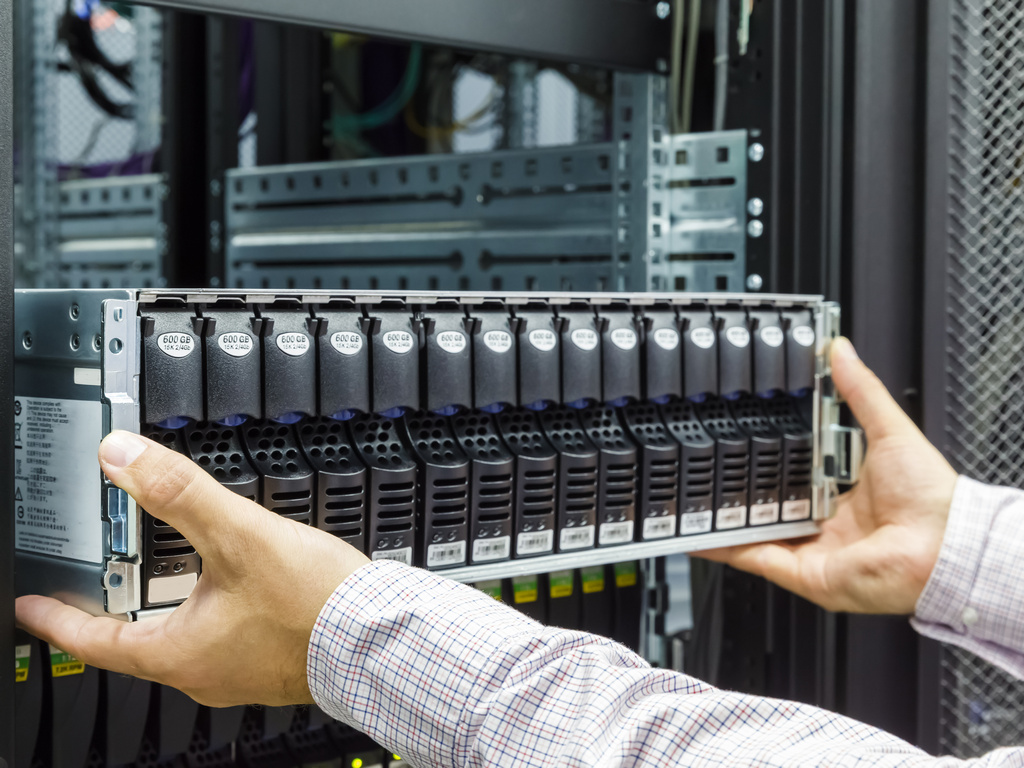
They have a much higher energy consumption than traditional computing due to the greater computational power and specially developed hardware that is necessary for their functioning.
It is difficult to say exactly how much the future growth in energy needs of AI technologies will be, so all existing projections should be taken with a grain of salt.
Accelerated chip development
The accelerated growth in demand for data centers is not only being met by building new infrastructure, but also by new technologies for specialized AI chips, which are continuously evolving to consume less energy.
On the other hand, in addition to the capacity needed to power the chips themselves, data centers also require significant energy for cooling and other operational needs.
Another, entirely new challenge, specific to data centers, is that they are highly variable in the way they consume energy.
In fact, a paper published by Meta reported tens of megawatts of power fluctuations in their mid-sized clusters.
This could make it harder for grid operators to maintain the stability and reliability that are essential for the functioning of the power system.
More in-depth analyses of this phenomenon are still lacking; meanwhile, regulators in the US and Europe are currently in the process of setting rules for the observed fluctuations in signal behavior.
Can data centers also help us with the functioning of the energy system?
However, the development of data centers does not only lead to new challenges when it comes to energy. They can also create some new opportunities.
(Photo: Sergey Nivens/shutterstock.com)
AI cooling control systems that optimize the efficiency of data centers, or intelligent systems that understand the temporal and spatial flexibility of computing loads, and shift them to reduce CO2 emissions in the network – these are examples of approaches that are turning data centers into “carbon-conscious consumers.”
In addition to helping with consumption, AI-based solutions are already being used to increase the energy efficiency of thermostatically controlled energy demand, in the installation of renewable power plants, and even in vehicle routing to reduce CO2 emissions (you can read more about this in Google’s Environmental Report for this year).
Decarbonization and “sustainable computing”
In other words, if we want “sustainable computing” in the age of AI, our goal should not only be to decarbonize the sector and reduce the resulting emissions – but also to develop the data center infrastructure itself to support the transition to a more reliable, efficient, and sustainable electricity grid.
(Photo: Pixabay.com/Geralt)
In this sense, large consumers such as data centers have an important, but currently unfulfilled, role in enabling a low-carbon, affordable, and reliable electricity supply.
While investing in grid development is a slow and expensive process, data centers need to increase their flexibility when it comes to demand, to enable faster connection to congested grids, control electricity prices for all, and to be able to decarbonize energy sources.
One source of this flexibility is computing that is spatially and temporally flexible: data centers could regulate electricity demand by controlling when and where computing operations (including AI) are performed.
Investing in renewables
Furthermore, more investment should be made in energy storage and clean and renewable sources close to data centers themselves, to increase flexibility in their demand and reduce overall consumption.
(Photo: eKapija / Aleksandra Kekić)
This requires an understanding of both computing systems and how the grid works, and the ability to develop solutions that incorporate existing (or create new) structures and rules in energy markets.
Initial studies conducted in collaboration with grid experts and distributors reveal the important role that data center flexibility can play in the development, reliability, accessibility and decarbonization of the grid.
It is the only sustainable way we can address the growing energy needs of AI technology.
Tags:
Ana Radovanović
Google
Meta
energy
AI
artificial intelligence
data centers
electricity consumption
Comments
Your comment
Naš izbor



Most Important News
Full information is available only to commercial users-subscribers and it is necessary to log in.
Pratite na našem portalu vesti, tendere, investicione projekte, grantove i pravnu regulativu.
Registracija na eKapiji vam omogućava pristup potpunim informacijama i dnevnom biltenu
Naš dnevni ekonomski bilten će stizati na vašu mejl adresu krajem svakog radnog dana. Bilteni su personalizovani prema interesovanjima svakog korisnika zasebno,
uz konsultacije sa našim ekspertima.